
Free printable spatial with answers
Pick a puzzle type and a grade, generate a printable puzzle and its answer, and print two pages. Count the cubes in a 3D stack, draw a solid's three views, or build the solid from its views, all drawn by the same engine behind our KDP Publisher Studio.
By puzzle type
Cube counting puzzles
Free printable cube counting puzzles with answers. Count every cube in a 3D stack, including the hidden ones. One click, no sign-up.
Draw the views puzzles
Free printable draw-the-views puzzles with answers. See a 3D solid, then draw its top, front and side view on the grids. No sign-up.
Build the solid puzzles
Free printable build-the-solid puzzles with answers. Read three flat views, then draw the one 3D shape that fits all of them. No sign-up.
By difficulty
Easy cube counting puzzles
Free printable easy cube counting puzzles with answers. Small stacks of 4 to 14 cubes, with little or nothing hidden. One click, no sign-up.
Hard cube counting puzzles
Free printable hard cube counting puzzles with answers. Big stacks of up to 130 cubes with at least 40 hidden. No sign-up.
Expert cube counting puzzles
Free printable expert cube counting puzzles with answers. A 12 by 12 by 12 stack of up to 260 cubes, 70 or more hidden. No sign-up.
By age and format
Spatial reasoning puzzles for kids
Free printable spatial reasoning puzzles for kids with answers. Count the cubes in a small 3D stack. Easy grade, no sign-up.
11 plus spatial reasoning practice
Free printable 11 plus spatial reasoning practice with answers. Read a 3D solid and draw its top, front and side view. No sign-up.
Spatial reasoning puzzles for adults
Free printable spatial reasoning puzzles for adults with answers. Large cube stacks with dozens of hidden cubes to reason out. No sign-up.
Isometric drawing worksheets
Free printable isometric drawing worksheets with answers. Draw a solid on isometric dot paper from its three views. No sign-up.
Orthographic projection worksheets
Free printable orthographic projection worksheets with answers. Draw the plan, front and side elevation of a 3D solid. No sign-up.
Printable spatial puzzles
Free printable spatial puzzles with answers, ready in one click. Count cubes, draw views or build a solid. Print two pages. No sign-up.
Spatial reasoning puzzles with answers
Free printable spatial reasoning puzzles with answers. Every puzzle prints with a worked answer page you can check against. No sign-up.
One answer, and the drawing to check it against
Each solid is built first and the puzzle read off it, so the answer is the thing the question was made from rather than a second guess at it. Counting puzzles have one number, and the view puzzles have one set of views, which is why a stack is never drawn with a cube hidden where it cannot be counted.
How to solve a spatial puzzle
A spatial puzzle hands you a flat drawing of a 3D shape and asks you to picture it whole: how many cubes are stacked, including the ones hidden behind, or which view you would see once the shape is turned.
The method
- 1Read the drawing as a solid. The picture is drawn in isometric 3D, so each cube sits on the one below it. Read it as a stack of blocks rather than a flat pattern.
- 2Count column by column, including the hidden cubes. For a counting puzzle, work across the base one column at a time and add the cubes you cannot see but that must be there. A cube in the air always has a column holding it up.
- 3For a rotation, turn it a quarter at a time. For a "which view" puzzle, rotate the shape in your mind in single quarter-turns and track where one landmark corner lands, rather than flipping the whole thing at once.
- 4Check against the answer. The count, or the matching view, is printed on the facing page, so you can confirm the hidden cubes you inferred were really there.
- The one idea
- Every spatial puzzle is the same skill: holding a 3D shape in your head from a 2D drawing. The families (count the cubes, mental rotation) ask for it in different ways.
- What the answer page shows
- The cube count, or the correct rotated view, on the facing page.
- How the grades differ
- A roomier lattice means more cubes and deeper occlusion, so more of them are hidden and the count is harder to be sure of.
- Good for
- Building the spatial reasoning that maths and design lean on, for older children through to adults.
How each type works
Three directions of the same skill. Counting goes from a 3D drawing to a number, draw the views goes from 3D to flat, and build the solid goes from flat back to 3D. Each block below is the how-to page the studio prints at the front of a book of that type.
3D to a number
Count the cubes
A stack of unit cubes drawn in 3D on a faint floor grid, and one question: how many cubes make up the figure, including the ones you cannot see?
How to solve it
- 1Count what you can see, from the bottom up. Work one layer at a time. Count the cubes in the base, then the next layer, and so on to the top.
- 2Add the hidden cubes. A cube sitting high up must have cubes underneath holding it up. Those supporting cubes count too, even when you cannot see them.
- 3Check the base is solid. Wherever a tall stack stands, every cube below it is there. Add those in and you have the total.
- The one rule that makes it solvable
- Every cube rests on another, so nothing floats in the air, and the whole figure is one connected piece. That is how you know a hidden cube is really there.
- What the answer page shows
- The answer page repeats the figure with the total printed beneath it.
- How the grades differ
- Easy is a 3 by 3 by 3 stack of 4 to 14 cubes. Medium is 4 by 4 by 4 with up to 26. Hard is 8 by 8 by 8 with up to 130 cubes and at least 40 hidden. Expert is 12 by 12 by 12 with up to 260 cubes and at least 70 hidden.
- Good for
- A first spatial puzzle for children, reasoning-test practice, and adult solvers at the hard and expert grades.
3D to flat
Draw the views
A solid drawn in 3D, with arrows marking the top (T), front (F) and side (S), and three empty grids beside it.
How to solve it
- 1Top view: look straight down. Like a bird above the shape. Shade a square wherever a stack of cubes stands, no matter how tall.
- 2Front and side views: look level. Face the shape head on, then from the side. Shade a square wherever any cube reaches that width and height.
- 3A square is filled if anything is behind it. A view is a shadow on a grid, not a count, so depth does not matter, only whether a cube lines up there.
- Check your work
- Lay your three views beside the solid. Every stack of cubes should cast a shaded square in all three, and no empty column should.
- What the answer page shows
- The answer page shows the same solid with all three grids shaded in.
- How the grades differ
- Difficulty is how many features are cut into or added to the solid, such as notches, steps, tunnels and slopes, not the size of the grid. The figures stay small enough to draw by hand at every grade.
- Good for
- Plan and elevation practice, technical drawing lessons, and the closest match to what spatial reasoning papers ask.
Flat to 3D
Build the solid
Three filled-in views, top, front and side, and a sheet of isometric paper below them to draw on.
How to solve it
- 1The top view is your map. It shows which floor squares hold a stack of cubes. Start by marking those columns.
- 2The front and side views give the height. Each one caps how tall a column may grow along that direction. A column can only be as tall as both views allow, so take the shorter answer.
- 3Build from the floor up, then check. Place cubes so none float. When all three views match your shape, you are done.
- A promise about every puzzle
- Exactly one shape fits all three views with no floating cubes. If you find a shape that matches, it is the answer, and there is no other.
- What the answer page shows
- The answer page draws the solid on the isometric grid.
- How the grades differ
- Difficulty is how many features the solid has, such as notches, steps and tunnels. Slopes are left out of this type on purpose: a sloped face cannot be pinned down from flat views alone, and every puzzle here must have one answer.
- Good for
- Isometric drawing practice, the reverse of plan-and-elevation work, and the hardest of the three for a confident solver.
Buy a finished spatial book
Done and formatted, graded easy to expert. Instant PDF download on Etsy, then print at home.
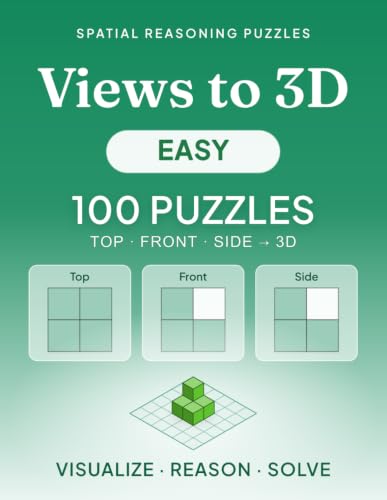
Views to 3D: Easy: 100 Spatial Reasoning Puzzles with Top, Front & Side Views
Printed bookEasy100 easy spatial reasoning puzzles: reconstruct the 3D solid from its top, front and side views.
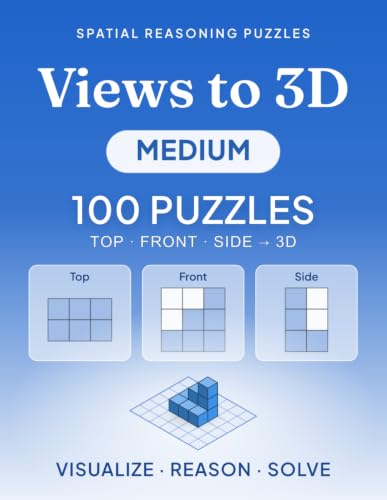
Views to 3D: Medium: 100 Spatial Reasoning Puzzles with Top, Front & Side Views
Printed bookMedium100 medium spatial reasoning puzzles: reconstruct the 3D solid from its top, front and side views.
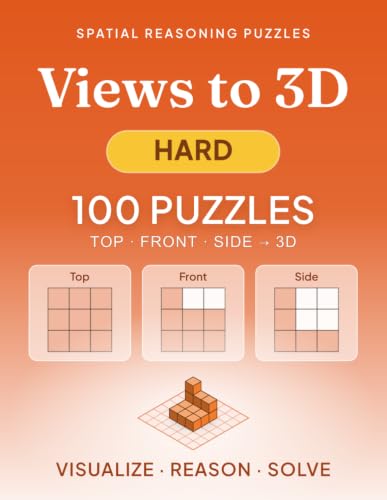
Views to 3D: Hard: 100 Challenging Spatial Reasoning Puzzles with Top, Front & Side Views
Printed bookHard100 challenging spatial reasoning puzzles: reconstruct the 3D solid from its top, front and side views.
Make one now
Pick a type and a grade, then print the puzzle and its answer. No sign-up, no watermark.